Amrit Snan (Holy Bath)
The Nectar of ImmortalityLearn about the most sacred ritual of the Kumbh Mela—the Amrit Snan, or holy bath, believed to cleanse sins and offer liberation.
To truly understand the power of the Amrit Snan, one must look at the ancient origins, the specific sacred locations in Nashik, and the disciplined traditions of the Akharas that define this event.
The Mythological Legend: Briefly explain the Samudra Manthan (Churning of the Ocean) and how drops of Amrit (nectar) fell into the Godavari River. This explains why it’s called “Amrit Snan.”
Amrit Snan (Holy Bath) Significance
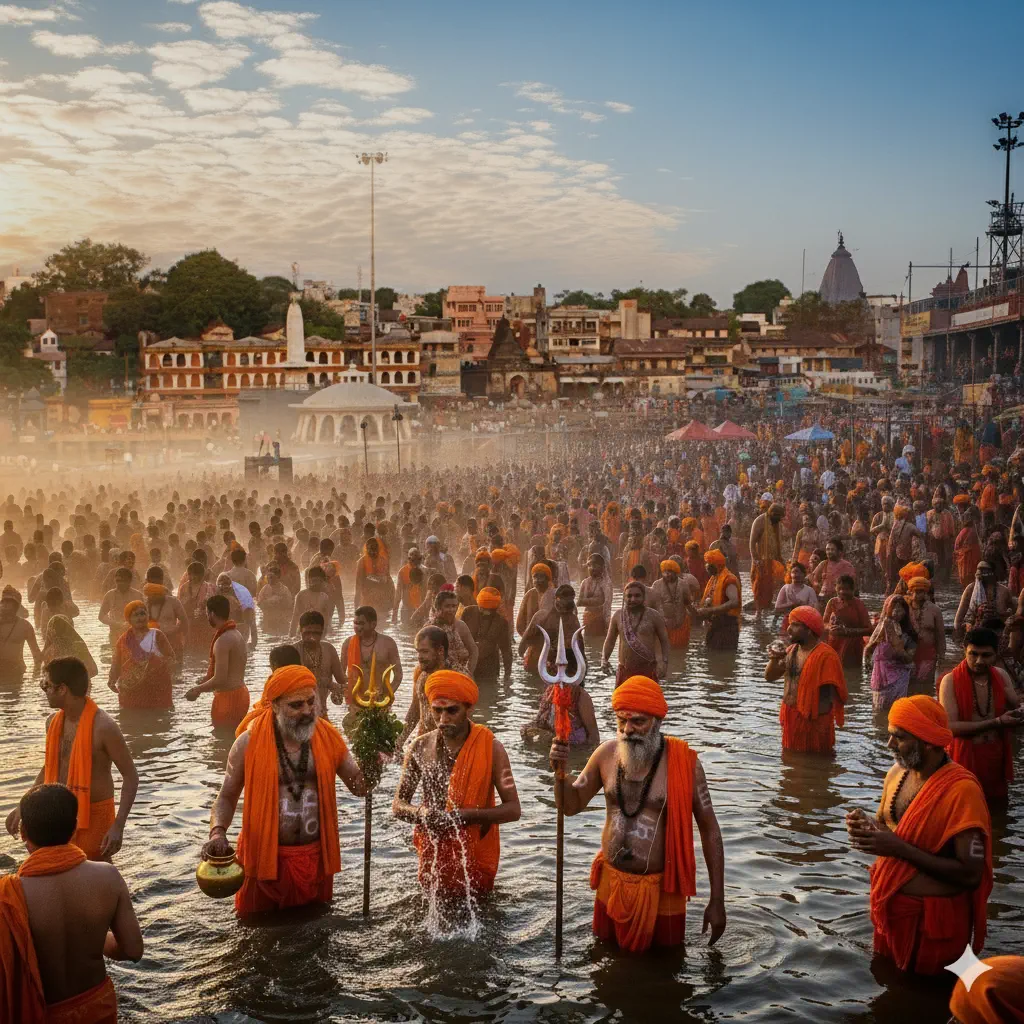
The Amrit Snan, or Holy Bath, is the most sacred and central ritual of the Kumbh Mela. It is a mass immersion in the waters of the Godavari River on specific, astrologically auspicious days, believed to be the most potent moments of the entire festival. Pilgrims from all walks of life—from revered sages to humble devotees—gather at the banks to take part in this transformative act of purification.
The belief behind the Amrit Snan (Holy Bath) Significance is deeply rooted in Hindu mythology. The water is believed to turn into amrita, the nectar of immortality, for a brief period. A bath during this time is said to wash away a person’s sins, cleanse their soul, and free them from the cycle of reincarnation. The air at the bathing ghats becomes charged with spiritual energy, and the sight of millions of people performing this ritual together is a powerful testament to collective faith. For many, taking the Amrit Snan is a once-in-a-lifetime experience that marks the culmination of their spiritual journey.
1. The Mythological Origin (The Legend of the Kumbh)
The significance of the Amrit Snan is tied to the Samudra Manthan (Churning of the Ocean). According to the Puranas:
-
The Struggle: Gods (Devas) and Demons (Asuras) churned the cosmic ocean to obtain Amrit (the nectar of immortality).
-
The Flight: When the pot (Kumbh) emerged, a celestial flight ensued to keep it away from the demons. During this 12-day chase (equivalent to 12 human years), drops of the nectar fell at four places: Prayagraj, Haridwar, Ujjain, and Nashik.
-
The Sanctification: It is believed that at specific astrological moments, the Godavari River in Nashik once again turns into this divine nectar. Bathing during these windows is not just a physical act but a “dip into immortality.”
2. Why “Amrit Snan” Instead of “Shahi Snan”?
You may notice the term “Amrit Snan” being used more frequently now.
-
Historical Context: For centuries, these were called Shahi Snan (Royal Baths). The term “Shahi” is of Persian/Urdu origin, reflecting the “royal” pomp and pageantry of the ascetics.
-
Cultural Revival: Recently, there has been a shift toward the Sanskrit term Amrit Snan. This emphasizes the spiritual result of the bath (attaining nectar/immortality) rather than just the regal nature of the procession.
3. The Role of the Akharas (The Royal Procession)
The Amrit Snan is defined by the Peshwai—the grand processions of the Akharas (ancient orders of Hindu warrior-sadhus).
-
The Sequence: The general public is only allowed to bathe after the Akharas have completed their rituals. In Nashik, the Vaishnava Akharas (devotees of Vishnu) bathe at Ramkund, while the Shaiva Akharas (devotees of Shiva) traditionally bathe at Kushavarta Kund in Trimbakeshwar.
-
The Energy: The arrival of thousands of Naga Sadhus, covered in holy ash and chanting “Har Har Mahadev,” is said to charge the river water with intense spiritual vibrations, which pilgrims then “absorb” during their own dip.
4. Key Locations in Nashik & Trimbakeshwar
While both are sacred, the choice of where to bathe often depends on your spiritual path. You can read our detailed guide on
5. Upcoming Important Dates (2027-2028 Cycle)
The Amrit Snan dates are the peak of the festival, but many other rituals happen throughout the month. View the complete
6. The “Science” Behind the Bath
From a Vedic perspective, the timing of the Amrit Snan is not random. It occurs when Jupiter enters Leo (Simha) and the Sun and Moon are in specific alignments. Practitioners believe these planetary positions create a unique electromagnetic or “spiritual” pull on the Earth’s waters, enhancing the purification process of the human “bio-field” or soul.
7. Spiritual Benefits for the Pilgrim
-
Karma Cleansing: It is believed to wash away Sanchita Karma (accumulated sins from past lives).
-
Moksha: Facilitates the path to liberation from the cycle of birth and death.
-
Ancestral Blessing: Many perform Tarpan (offerings to ancestors) during the Amrit Snan, believing the nectar-filled water brings peace to departed souls.
Plan Your 2027 Pilgrimage
-
Track Progress: Stay updated on new roads, bridges, and airport expansions with our
Nashik Kumbh Mela 2027 Infrastructure Tracker -
Explore the City: Discover other sacred temples and ghats in our guide to
Key Locations in Nashik -
Travel Guide: Coming from out of state? Find the best trains, flights, and bus routes in our guide on
How to Reach Nashik